
Find Divorce Decree Records in Duluth
Duluth divorce decree records are maintained by the Gwinnett County Superior Court, which serves as the court of record for all divorce filings in Duluth and throughout Gwinnett County. Whether you're searching for your own case or looking up an older record, this guide covers the court's contact details, what divorce case files contain, Georgia law that governs the process, and where to find help if you need it.
Duluth Divorce Decree Quick Facts
Gwinnett County Superior Court: Duluth Divorce Records
All divorce cases for Duluth residents are filed at the Gwinnett County Superior Court. The courthouse and clerk's office are located at 75 Langley Drive, Lawrenceville, GA 30046. Lawrenceville is the county seat and where the clerk maintains all court records, including those from cases filed by Duluth residents. You can reach the clerk by phone at (770) 822-8100. The official court website is gwinnettcourt.org.
If you want to request records by mail rather than visit in person, send your written request to PO Box 880, Lawrenceville, GA 30046-0880. Include the names of both parties, the approximate year the divorce was finalized, and any case number you have. Mail requests take longer than in-person visits, so plan accordingly. Certified copies are available for a fee, and the clerk's office can tell you the exact amount when you contact them.
Gwinnett County handles a very large volume of civil cases. Having good case information before you contact the clerk saves time. Walk-in visits work well if you can get to Lawrenceville during business hours.
The Gwinnett County Superior Court divorce records page below shows the official court portal where Duluth residents can search for divorce case information and request records.
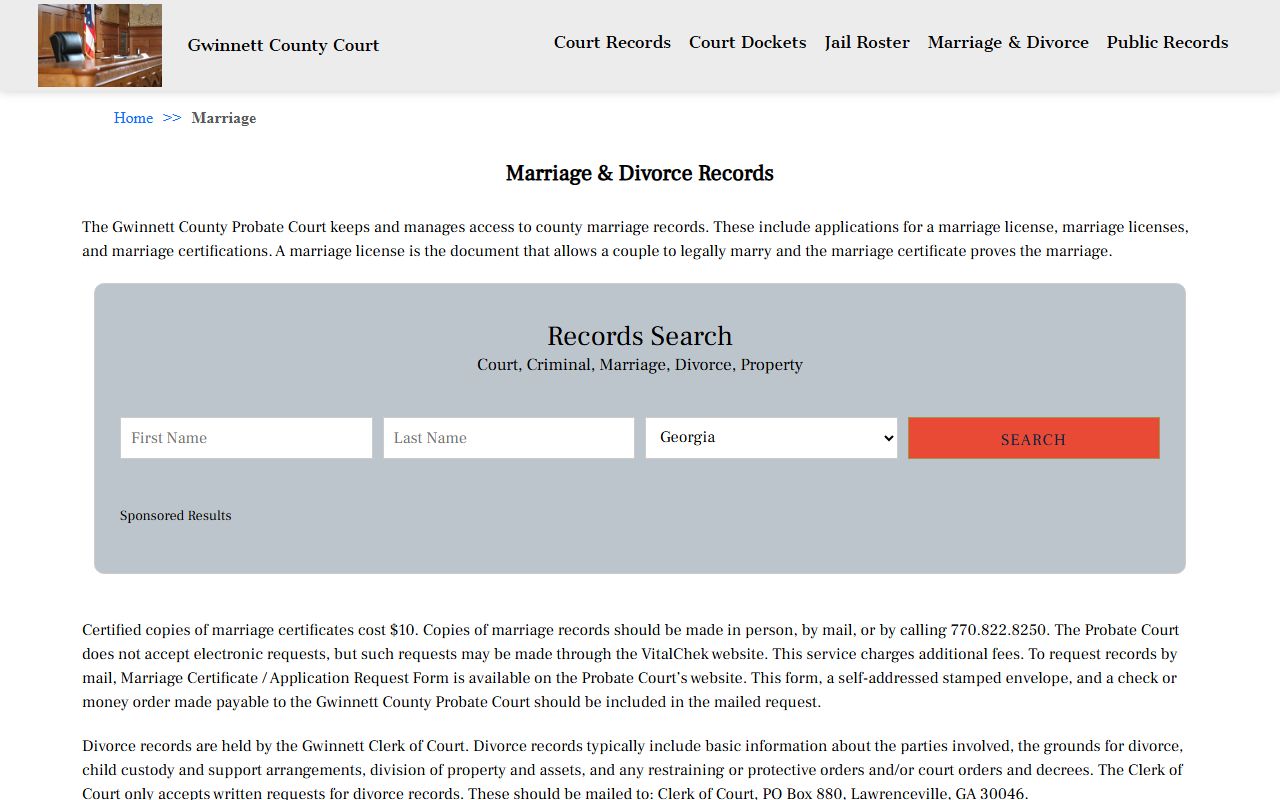
The page includes links to case search tools and instructions for requesting certified copies of divorce decrees.
What Duluth Divorce Decree Files Contain
A divorce decree is the judge's final written order. It closes the case and lays out the terms of the divorce. For a Duluth case, the decree will typically address property division, any debt allocation, and whether alimony applies. If the couple has children, the decree will also spell out custody, visitation schedules, and child support amounts.
The full case file has more than just the decree. It usually includes the original divorce petition, the other party's answer, any temporary orders entered during the case, financial disclosure statements, and the settlement agreement if the parties resolved things out of court. All of these documents are part of the court record held by the Gwinnett County clerk.
Note: Some records or portions of files may be restricted. Sections involving children's personal data or certain sensitive details can be sealed by the court. If a document you're looking for isn't available, ask the clerk whether any part of the file has been sealed.
Georgia Divorce Law: What Applies in Duluth
Georgia law places all divorce jurisdiction in the Superior Court system. Under OCGA 19-5-1, the Superior Court is the only court that can grant a divorce in the state. That's why every Duluth divorce is a Gwinnett County Superior Court case, no matter how simple or complex the matter is.
Before filing in Georgia, at least one spouse must have lived here for at least six months. This comes from OCGA 19-5-2. For Duluth residents, that means six continuous months of Georgia residency before the petition hits the clerk's desk. If both spouses are Georgia residents, either one can file, and the case goes to the county where either spouse lives.
Georgia law lists 13 grounds for divorce under OCGA 19-5-3. The most widely used is the no-fault ground, which says the marriage is irretrievably broken. It's simpler to prove and avoids the need to argue fault in court. But Georgia does recognize fault grounds too, like adultery, cruel treatment, and habitual intoxication, and those can factor into alimony decisions.
After the respondent is served with the divorce papers, there's a mandatory waiting period of at least 30 days before the court can enter a final decree. Most contested cases take much longer. The petition itself must be in writing and signed under oath, per OCGA 19-5-5.
The Georgia Courts divorce forms page below lists the official forms used in Georgia Superior Court divorce cases, including the forms filed in Gwinnett County for Duluth cases.
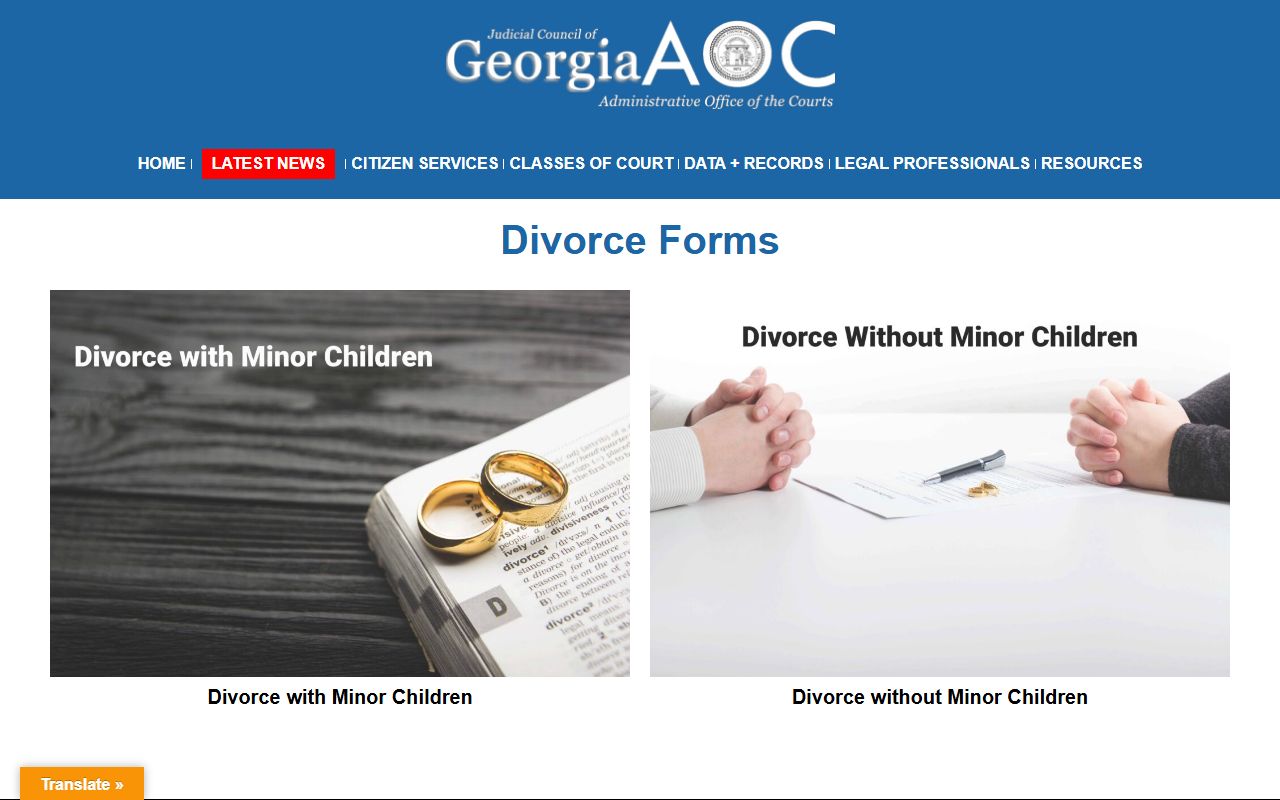
The forms library covers petitions, financial disclosures, and final decree templates accepted by Georgia courts.
Public Access to Duluth Divorce Records
Georgia's Open Records Act, codified at OCGA 50-18-70, makes most court records available to the public. Divorce decrees filed in Gwinnett County are public records. That means anyone can go to the clerk's office, request a case file, and get copies of the decree and associated documents, subject to any sealed portions.
Courts can restrict access to specific records in limited situations. Family law cases that involve details about minor children are the most common type where sealing occurs. But even when parts are sealed, the existence of the case and the parties' names typically remain in the public index.
Georgia Courts provides general information for people navigating the court system at georgiacourts.gov. Divorce forms and self-help materials are available at georgiacourts.gov/a2j/self-help-resources/family-law/divorce-forms/. These resources can give you a sense of what documents to expect in a typical divorce case file.
Legal Help for Duluth Residents
If you need legal guidance on a divorce matter in Duluth, a few organizations can help. Georgia Legal Services Program at glsp.org serves low-income residents across the state, including those in Gwinnett County. They handle family law matters and can assist with divorce-related questions.
Georgia Legal Aid at georgialegalaid.org offers a searchable directory of legal aid resources by county. The State Bar of Georgia at gabar.org runs a lawyer referral service for people who want to hire a private attorney. Many family law attorneys in the Gwinnett County area offer free or low-cost initial consultations.
For people who want to handle their divorce without a lawyer, the self-help forms on the Georgia Courts website are a good place to start. Uncontested divorces, where both spouses agree on everything, are well-suited to a pro se approach.