
Find Johns Creek Divorce Decree Records
Johns Creek divorce decree records are on file with the Fulton County Superior Court, which handles all divorce filings for Johns Creek residents as part of the Fulton County court system. This page covers how to access and obtain those records, what they contain, what Georgia law requires for a divorce case in Johns Creek, and where to get legal help if you need it.
Johns Creek Divorce Decree Quick Facts
Fulton County Superior Court: Johns Creek Divorce Records
Johns Creek is in the northeast corner of Fulton County, and all divorce cases for its residents are handled by the Fulton County Superior Court. The Clerk of Superior Court is at 136 Pryor Street SW, Suite C155, Atlanta, GA 30303. Phone: (404) 613-5313. The court website is fultoncountyga.gov/Superior-Court, and the divorce and marriage records section is at fultoncountycourt.us/divorce-records.
Johns Creek incorporated as a city in 2006, but divorce jurisdiction in Georgia has always followed county lines. So whether a case was filed before or after incorporation, the Fulton County Superior Court is where Johns Creek divorce records are kept. The courthouse is in downtown Atlanta, roughly 25 to 30 miles from Johns Creek depending on your route. Calling ahead is worthwhile to confirm hours and what you'll need before making the trip.
Certified copies of decree pages cost $2.50 for the first certified page. The filing fee for a new divorce case in Fulton County is $223. Plain copies are less expensive if you don't need the official seal. Have the names of both parties and the approximate year of the divorce ready when you contact the clerk. A case number makes the search faster, but most records can be found with names alone if you have a rough time frame.
As the Fulton County court notes, "A divorce certificate may be needed for name changes or remarriage." The certificate is the short form. The full decree is what you need when legal enforcement or proof of specific terms is the issue.
The Fulton County Clerk of Superior Court website is the official source for Johns Creek divorce decree records and case information.
The Fulton County Clerk of Superior Court website provides access tools, contact details, and guidance for Johns Creek residents seeking divorce decree copies.
The Fulton County Clerk's website serves Johns Creek residents with court information, record search tools, and instructions for obtaining certified divorce decree copies.
What a Johns Creek Divorce Decree Contains
A divorce decree is the court's final order in a divorce case. It ends the marriage and sets out every legal term both parties must follow going forward. The terms are enforceable in court, not just advisory.
Most Johns Creek divorce decrees include the full names of both spouses, the date the court granted the divorce, the ground for divorce, child custody arrangements and visitation schedules if children were part of the case, child support amounts and payment schedules, any alimony or spousal support orders, a division of marital property and debts, and court-ordered name changes if requested. If the parties reached a settlement agreement before the hearing, that agreement is often incorporated directly into the decree.
A divorce certificate, by contrast, is a short administrative document confirming the divorce happened. It's useful for things like applying for a marriage license again or updating a name on a passport. But for legal enforcement, such as proving custody rights or collecting overdue support, the full decree from the Fulton County clerk is required. Certified copies carry the court seal and are what most official agencies want to see.
If modifications were made after the original decree, such as a change in custody or support, those orders are separate filings under the same case number. Ask the clerk for all documents in the case if you need the complete current state of all terms, not just the original final order.
Georgia Divorce Law for Johns Creek Residents
Every Johns Creek divorce is governed by Georgia state law. Under OCGA 19-5-1, the Superior Court has exclusive jurisdiction over divorces in Georgia. The Fulton County Superior Court is the only court that can grant a divorce for a Johns Creek resident. No other local or city court has that power.
The residency requirement in OCGA 19-5-2 requires at least one spouse to have been a Georgia resident for six months before filing. Once the divorce petition is served on the other party, the law requires a 30-day waiting period before the court can issue a final decree. This is mandatory for all Georgia divorces. After the 30 days pass, an uncontested case can usually be scheduled for a final hearing relatively quickly.
Georgia recognizes 13 grounds for divorce, listed in OCGA 19-5-3. The vast majority of Johns Creek divorces use the no-fault "irretrievably broken" ground. The petition itself must be a written document verified by the person filing, as required by OCGA 19-5-5. Verification means the petitioner swears under oath that the facts are accurate.
Public Access and Open Records
Johns Creek divorce decrees are public records. Georgia's Open Records Act, OCGA 50-18-70, gives anyone the right to request and inspect court records that haven't been sealed by a judge. You don't need to be a party to the case or give a reason. Any member of the public can request a Johns Creek divorce decree from the Fulton County clerk.
A judge can seal a case when it contains sensitive information, such as financial account details or information about minor children. If a file is sealed, the clerk will let you know. Getting access requires court approval. That's not the norm for most Johns Creek divorce cases.
For older divorces, the Georgia DPH at 1680 Phoenix Boulevard, Suite 100, Atlanta, GA 30349, phone (404) 657-2700, website dph.georgia.gov/VitalRecords, can verify divorces from 1952 to 1996. But the DPH confirms events. For the full decree document, the Fulton County clerk is the source. Georgia.gov also offers vital records guidance at georgia.gov/request-vital-records.
Note: For the most current access options, including any online search tools the court may offer, check the Fulton County court website or call the clerk directly before your visit.
The Georgia.gov vital records page provides guidance on how to request divorce records and verifications, pointing Johns Creek residents to the right state and county agencies.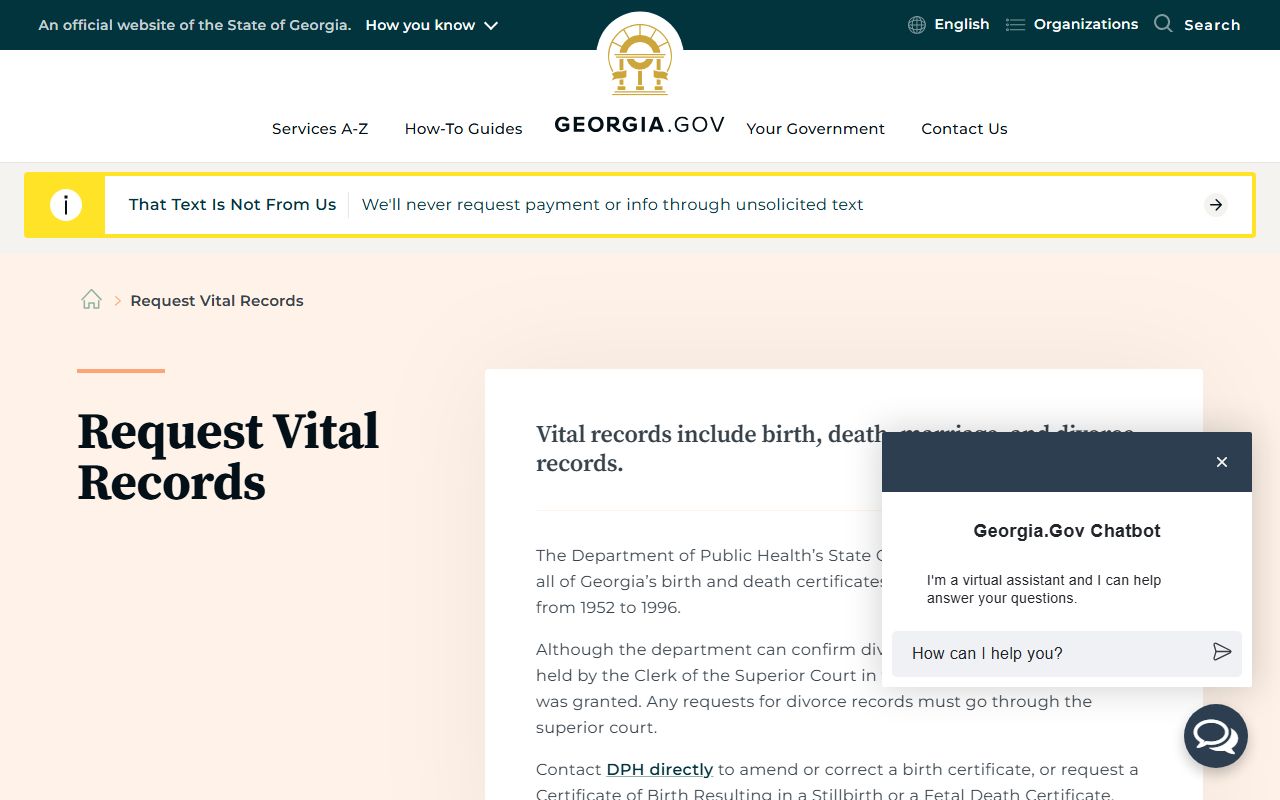
Georgia.gov's vital records guidance directs Johns Creek residents to the appropriate county and state offices based on the type of divorce record they need.
Legal Help for Johns Creek Divorce Cases
Several resources are available if you need legal assistance with a Johns Creek divorce matter. Georgia Legal Services Program at glsp.org provides free legal help to qualifying residents. Georgia Legal Aid at georgialegalaid.org has guides and local resources for people navigating divorce and family law matters on their own. Both are good starting points.
The State Bar of Georgia at gabar.org has a lawyer referral service for finding private family law attorneys in the north Fulton area. Johns Creek has a number of family law practices given its large residential population. If you're going the self-represented route, official Georgia divorce forms are available at georgiacourts.gov/a2j/self-help-resources/family-law/divorce-forms/. These forms are used in Fulton County Superior Court. Make sure you're using the current version before filing.