
Douglas County Divorce Decree Records
Douglas County divorce decree records are maintained by the Clerk of Superior Court in Douglasville, Georgia. The clerk's office handles all civil and family case files in the county, including divorce decrees. Under Georgia law, most divorce records are public and anyone can request a copy. This guide explains how to get Douglas County divorce records, what those documents contain, the fees involved, and where to find legal assistance.
Douglas County Divorce Decree Quick Facts
How to Get Douglas County Divorce Decrees
For divorce decrees, land records, or criminal and civil case files in Douglas County, contact the Clerk of Superior Court. The office is at 8700 Hospital Drive, Douglasville, GA 30134, and can be reached by phone at (770) 920-7252. The dedicated clerk of superior court line for land and civil case files, including divorce decrees, is (770) 920-7441. You can also check the Douglas County website for hours and service information, and visit their Records Department page for more detail on how to request records.
When you go to the clerk's office, bring the full legal names of both parties in the divorce and the approximate year the divorce was filed. A case number will speed things up, but it is not required. Bring a valid photo ID. Staff can search by name or case number and pull the file if it is on-site. The Records Department at Douglas County specifically handles document requests and can help you determine the correct form of request and current fees.
Mail requests are accepted. Send a written request to 8700 Hospital Drive with case details, your contact information, and a self-addressed stamped envelope. Include payment for copy fees. Under Douglas County's open records policy, each photocopy costs $0.10 per page, with no charge for the first quarter hour of staff time spent on the request. This is one of the more transparent fee structures in Georgia. Confirm current rates before mailing, as fees can be updated.
Birth certificates, death certificates, marriage records, and estate-related documents are handled by Probate Court in Douglas County, not the Superior Court clerk. If you need those records, contact the Probate Court at (770) 920-7249. For divorce decrees specifically, the Superior Court clerk at (770) 920-7441 is your contact.
Residents of Douglasville file divorce cases with the Douglas County Superior Court. The Douglasville courthouse at 8700 Hospital Drive serves both city and county residents.
What Douglas County Divorce Records Contain
A Douglas County divorce decree is the final order from Superior Court that ends a marriage. The document names both parties, states the date of the divorce, carries the judge's signature, and lays out all the terms the court approved. Property division, debt allocation, any spousal support ordered, and, in cases involving children, custody arrangements, visitation terms, and child support amounts are all spelled out in the decree. This is the document that both parties must follow and that courts use if enforcement becomes necessary.
The decree is one of the most important documents you will need after divorce. You need a certified copy to remarry legally in Georgia or another state. Government agencies require it for name change requests. Courts need it to enforce support or custody terms. Financial institutions may ask for it when changing account ownership. Getting extra certified copies at the time of your first request is often cheaper and easier than going back to the clerk for more later.
The full case file includes more than the final decree. It may contain the original divorce petition, financial affidavits, motions filed by either party, court orders issued during the case, and any settlement agreement. These documents are generally public in Douglas County. Some portions may be restricted under a court seal, particularly sensitive financial records or documents involving minor children. Note: The Douglas County Records Department can tell you which portions of a specific file are publicly accessible before you submit a request.
Douglas County Divorce Decree Fees
Douglas County's open records policy sets the per-page photocopy fee at $0.10 per page, with no charge for the first 15 minutes of employee time. Certified copies carry additional certification fees set by the clerk's office. Call (770) 920-7441 for the current certified copy fee schedule before your visit. The total cost depends on how many pages the decree spans and whether you need plain or certified copies. Most divorce decrees in Georgia run several pages once attached orders are included.
When a divorce case is first filed in Douglas County Superior Court, a filing fee applies. This fee is separate from the copy fees paid when requesting records later. The clerk's office can give you the current filing fee schedule. For those facing financial hardship, ask about fee waiver options. Georgia courts can waive fees for qualifying individuals, and the clerk can tell you what documentation is needed to request a waiver.
Note: Douglas County clerk's office typically accepts cash, check, or money order. The Records Department may accept additional payment methods. Confirm before your visit by calling (770) 920-7441.
Georgia Divorce Laws in Douglas County
All Douglas County divorces follow Georgia state law. Under OCGA 19-5-1, Georgia courts can grant divorces on a range of grounds. The no-fault ground of irretrievable breakdown of the marriage is the most common. Neither party has to prove wrongdoing to use this ground. Georgia also allows fault-based divorce under OCGA 19-5-3, which includes grounds such as adultery, desertion, cruel treatment, and habitual intoxication. Most Douglas County cases proceed on no-fault grounds.
Before filing in Douglas County, at least one spouse must have lived in Georgia for six months, as required by OCGA 19-5-2. Once the petition is filed, a 30-day waiting period applies before the court can issue a final divorce decree. If both parties agree on all terms, the case can often be resolved without a contested trial. Douglas County Superior Court has exclusive jurisdiction over divorce cases filed in the county.
Once a divorce decree is issued and filed in Douglas County, it becomes public under the Georgia Open Records Act. Public access is the default. Courts can order specific records sealed, but that is done case by case and is not the norm for most divorce decrees.
Public Access to Douglas County Divorce Records
Douglas County divorce records are public under Georgia law. Anyone can request a copy of a divorce decree from the Clerk of Superior Court. You do not need to be a party to the case. Visit the Records Department at 8700 Hospital Drive in Douglasville, provide the party names and approximate filing date, pay the copy fee, and you can receive a copy the same day if the file is available on-site.
The images below are from the Douglas County courthouse records system and the Douglas County clerk's office website, showing the records access process for divorce decrees in the county.
The Douglas County Records Department provides detailed information on how to submit records requests and what documents are available.
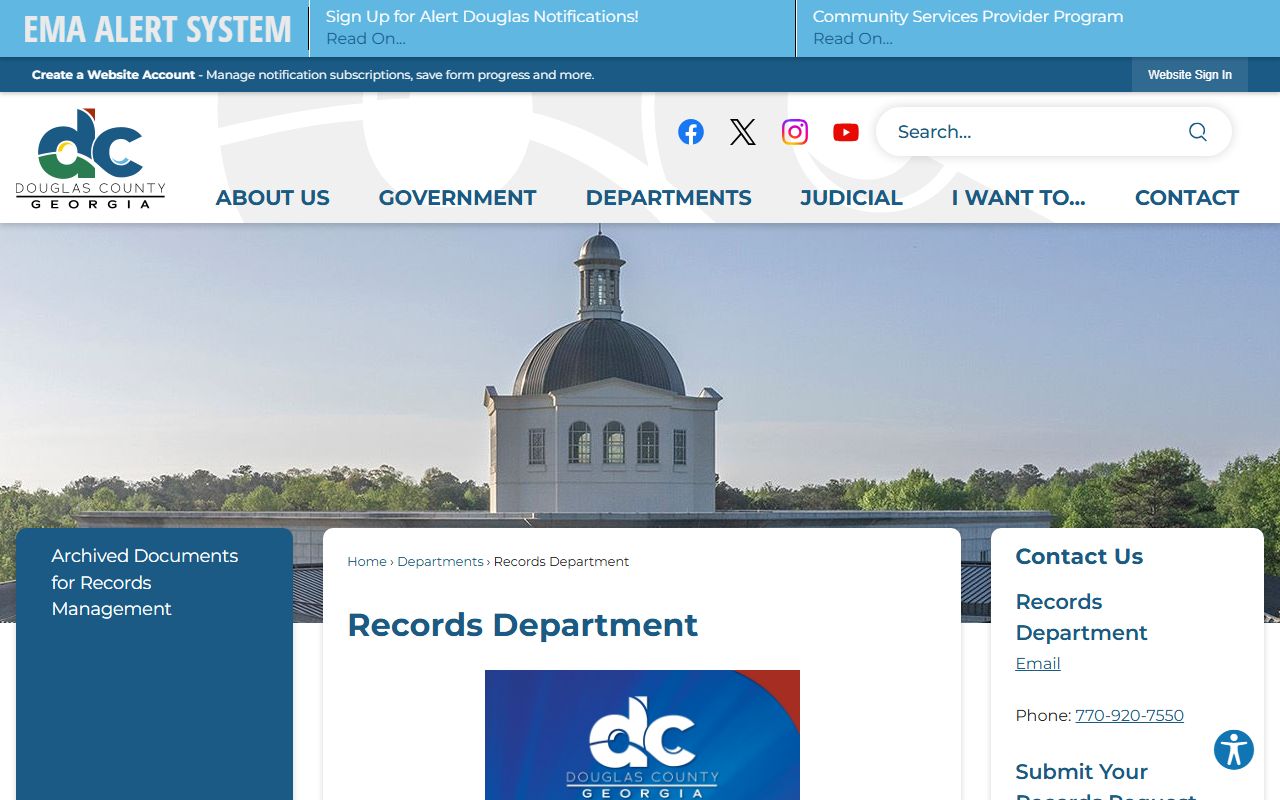
The Douglas County records system handles requests for divorce decrees through the Superior Court Clerk's office at 8700 Hospital Drive in Douglasville.
The Douglas County website and the clerk's office provide information about the records request process and current fees. The image below shows the Clerk of Superior Court office where divorce decree records are physically maintained.
For state-level divorce verifications from 1952 to 1996, the Georgia Department of Public Health at (404) 657-2700 maintains a separate database. These are verification records only. For certified copies of the full decree, the Douglas County clerk is the source.
Legal Help for Divorce in Douglas County
Georgia Legal Aid provides free legal services to qualifying Douglas County residents and can help with divorce filings, court procedures, and your legal rights. Georgia Legal Services Program may also offer assistance for eligible clients in the area. For those who prefer a private attorney, the State Bar of Georgia lawyer referral service can connect you with a family law attorney experienced in Douglas County cases.
Uncontested divorces where both parties agree on all terms can often be handled using self-help forms from the Georgia Courts self-help portal. For contested cases involving property, children, or fault-based grounds, consulting an attorney before filing is strongly recommended. The Douglas County clerk's Records Department can tell you what forms to file but cannot give legal advice.