
Douglasville Divorce Decree Records
Douglasville divorce decree records are filed with the Douglas County Superior Court, and the courthouse is located right in Douglasville itself, making it convenient for local residents to request copies in person. If you need to search for a divorce decree, get a certified copy, or confirm that a past divorce was finalized, this page walks you through where to go, what to ask for, and how Georgia law governs the process for cases filed here in Douglas County.
Douglasville Divorce Decree Quick Facts
Douglas County Superior Court Records
The Douglas County Superior Court Clerk's office handles all divorce filings for Douglasville and the rest of Douglas County. Because the courthouse sits in Douglasville, you don't need to travel to another city to get your records. The address is 8700 Hospital Drive, Douglasville, GA 30134. You can call them at (770) 920-7252 or visit the county website at douglascountyga.gov.
Douglas County has a dedicated Records Department that specifically handles divorce decree requests and certified copies. For copy requests, contacting that department directly is the fastest route. You can find their page at douglascountyga.gov/330/Records-Department. Having the full names of both parties and an approximate year for the divorce will help the staff locate the file quickly.
When you request a copy, the clerk's office will let you know what forms of ID or payment they accept. Certified copies carry a small fee. Plain copies may be available at a lower cost, though they may not be accepted in all legal or administrative contexts. If you need the copy for a court, government agency, or title company, ask for a certified copy to be safe.
The Douglas County Records Department page, shown below, is where to start for Douglasville divorce decree requests. Visit douglascountyga.gov directly for current contact details and request procedures.
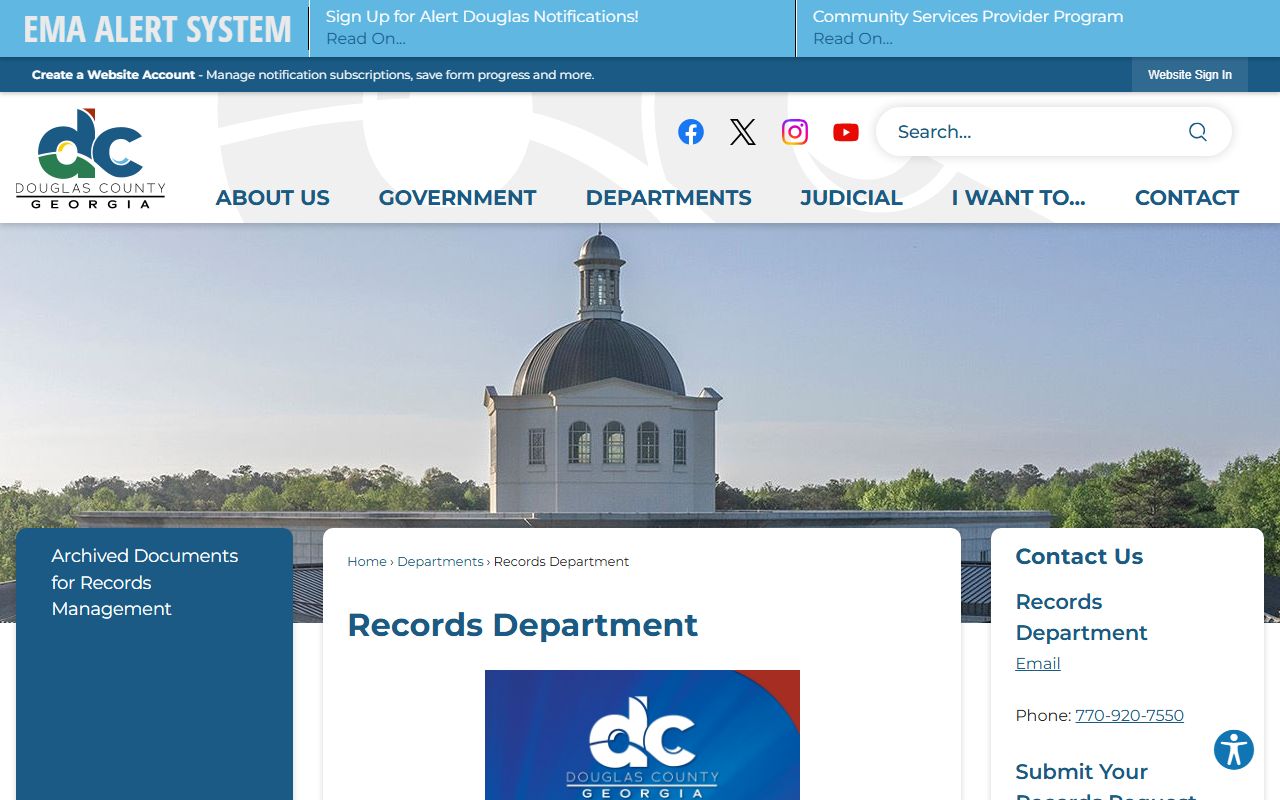
The screenshot shows the Records Department section of the Douglas County website, where residents can learn how to request divorce decree copies and other court records.
What Divorce Decrees Include
A divorce decree is a final court order issued by a Superior Court judge. It is the document that legally ends the marriage. For straightforward cases, it may be short and cover just the basic facts: the names of both parties, the date the divorce was granted, and confirmation that the marriage is dissolved.
More involved cases produce longer decrees. If property was divided, the decree will describe what each party receives. If children are involved, the decree will include custody arrangements, a parenting schedule, and child support terms. Alimony, if awarded, is spelled out in the decree as well. All of these terms are enforceable as court orders once the decree is signed and filed. That's why a copy of the decree is often needed years after the case closes, when someone remarries, sells a home, or deals with a support dispute.
Beyond the decree, the case file held by the clerk contains everything filed in the case: the original petition, responses, motions, financial documents, and any agreements the parties reached. You can usually request specific documents from the file rather than the entire thing. Note: If the case file is older, it may be stored offsite or in a different format; ask the clerk about retrieval times for older records.
Georgia Law as It Applies to Douglasville Cases
All Georgia divorces are governed by Title 19, Chapter 5 of the state code. The Superior Court has exclusive jurisdiction over divorce under OCGA 19-5-1. That means no other type of court in Georgia handles divorce cases, and every Douglasville divorce goes through the Douglas County Superior Court.
Before you can file in Georgia, you or your spouse must have lived here for at least six months. This requirement is set by OCGA 19-5-2. If you recently moved to Douglasville from another state, you may need to wait until that residency period is met before your case can be filed here.
Georgia law allows 13 grounds for divorce under OCGA 19-5-3. The no-fault ground, "irretrievably broken," is the one used in the vast majority of cases. It does not require proving that one person did something wrong; it just asks the court to recognize that the marriage has broken down beyond repair. After the other party is served with the divorce papers, there is a 30-day waiting period before the court can enter a final order. The initial petition must be in writing and signed under oath, as stated in OCGA 19-5-5.
State Vital Records and Divorce Verification
The Georgia Department of Public Health maintains a statewide divorce index for cases between 1952 and 1996. This is not a source for full decree copies. The DPH can confirm that a divorce occurred and provide basic information, but the full record stays with the county court. The DPH itself states that "although the department can confirm divorces, copies of the records are held by the Clerk of the Superior Court in the county where the divorce was granted."
For Douglasville cases inside that date range, you can use the DPH index as a starting point if you are not sure which county handled the case. But once you know it was Douglas County, you go straight to the Superior Court clerk for the actual document. The DPH is at 1680 Phoenix Boulevard, Suite 100, Atlanta, GA 30349, phone (404) 657-2700, and their online portal is at georgia.gov/request-vital-records.
Georgia's main vital records portal, shown below, is accessible at georgia.gov/request-vital-records and covers the process for requesting state-level divorce verifications and other vital documents.
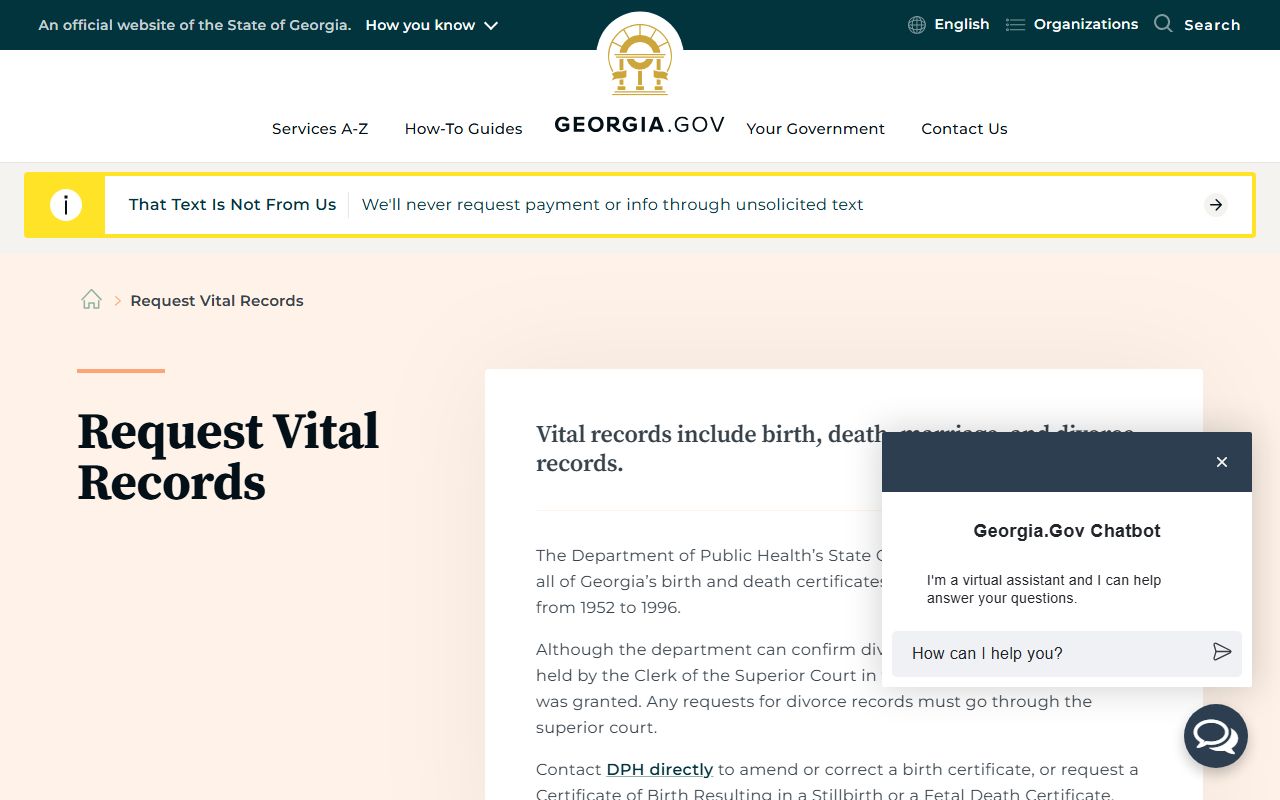
The screenshot shows Georgia's statewide vital records request portal, which handles divorce verifications for cases in the 1952-1996 index maintained by the Department of Public Health.
Open Records Access in Douglas County
Georgia's Open Records Act, codified at OCGA 50-18-70, makes most court records publicly accessible. Divorce decrees filed in Douglas County are public records. You do not need to be a party to the case to request a copy, and you don't need to explain why you want it.
Exceptions exist. A judge can seal a file if it contains sensitive information about minor children, financial data subject to a confidentiality order, or other matters where privacy interests are strong. Sealed files are not open to the public. If you encounter a sealed record, access would require a court order. For most cases, though, the records are open and available through the clerk's office during normal business hours.
Legal Resources for Douglasville Residents
If you need help with a divorce case or with getting records, free and low-cost legal resources are available in the area. The Georgia Legal Services Program at glsp.org assists people with limited income on civil legal matters including family law. They can help you understand your rights, complete paperwork, or respond to a divorce filing.
Georgia Legal Aid at georgialegalaid.org offers self-help guides and referrals for people navigating the court system without an attorney. The State Bar of Georgia's lawyer directory at gabar.org can connect you with a licensed family law attorney in Douglas County if you want professional representation. Self-represented filers can also download standardized divorce forms from georgiacourts.gov.