
Peachtree City Divorce Decree Search
Peachtree City divorce decree records are held by the Fayette County Superior Court in Fayetteville, and anyone who needs to find or obtain a decree tied to a Peachtree City case should start there. Whether you are searching for your own record, verifying a past divorce, or trying to get a certified copy for legal or personal use, this guide explains how the process works, what the records contain, and where to turn for help in Fayette County.
Peachtree City Divorce Decree Quick Facts
Where to Get Peachtree City Divorce Records
The Fayette County Superior Court Clerk handles all divorce filings for Peachtree City residents. The courthouse is located in Fayetteville, the county seat, not in Peachtree City itself. You will need to contact or visit the courthouse directly to request a certified copy of a divorce decree or to search for case files.
The clerk's office is at 1 Center Drive, Fayetteville, GA 30214. You can reach them by phone at (770) 716-4290 or visit the county website at fayettecountyga.gov. In-person requests are the most reliable way to get certified copies, though you should call ahead to confirm current hours and any specific request procedures the clerk's office uses.
When you visit or write in, be ready to provide the full names of both parties and the approximate year the divorce was granted. A case number helps but is not always required. The clerk can search by name if you don't have one.
What a Divorce Decree Contains
A divorce decree is the final court order that ends a marriage. It is signed by a Superior Court judge and filed with the clerk's office. The decree lays out the court's decisions on every issue the case involved. For a contested divorce, that can mean property division, debt allocation, child custody, parenting schedules, child support, and alimony. For an uncontested or simple divorce, it may be just a few pages that confirm the marriage is dissolved.
The decree itself is the legal document that proves a divorce happened. It names both parties, gives the date of the divorce, and identifies the court. Beyond the decree, the case file can hold a lot more: the original petition, financial disclosures, custody agreements, settlement agreements, and court orders entered during the case. If you need only proof that a divorce occurred, the decree alone is usually enough. If you need more detail, such as the terms of a custody or property arrangement, you may need to request the full case file.
Note: The Georgia Department of Public Health can confirm divorces that occurred between 1952 and 1996 but does not provide full decree copies. For anything outside that window, or for certified copies, go to the Fayette County Superior Court.
Georgia DPH Vital Records for Divorce Verification
The state's Division of Public Health maintains a separate index of divorce records for the years 1952 through 1996. This record is not a copy of the decree. It confirms that a divorce happened and provides basic identifying information, but it does not include the terms or the full court file.
The Georgia DPH website at dph.georgia.gov/VitalRecords is the place to start if you need a statewide divorce verification for cases in that date range. The department itself notes that "although the department can confirm divorces, copies of the records are held by the Clerk of the Superior Court in the county where the divorce was granted." So if you need the actual decree, the Fayette County clerk is still where you go regardless of the year.
The state DPH office is at 1680 Phoenix Boulevard, Suite 100, Atlanta, GA 30349. Their phone number is (404) 657-2700.
The Georgia DPH Vital Records site, shown below, is the starting point for statewide divorce verification for cases between 1952 and 1996. Visit dph.georgia.gov/VitalRecords to learn more about what the state index contains and how to submit a request.

The screenshot shows the main Vital Records landing page where users can find information about requesting divorce verifications for cases statewide.
Georgia Divorce Law and Peachtree City Cases
Georgia divorce law is governed by Title 19, Chapter 5 of the Official Code of Georgia Annotated. Under OCGA 19-5-1, the Superior Court has exclusive jurisdiction over divorce in Georgia, which is why all Peachtree City divorce cases are filed with the Fayette County Superior Court rather than any other court.
To file for divorce in Georgia, at least one spouse must have lived in the state for six months before filing. This residency rule comes from OCGA 19-5-2 and applies to anyone filing in Fayette County. If you moved to Peachtree City less than six months ago, you may not yet qualify to file here.
Georgia recognizes 13 legal grounds for divorce under OCGA 19-5-3. The most commonly used ground is that the marriage is "irretrievably broken," which is a no-fault option that does not require proving wrongdoing. Most Peachtree City cases use this ground. There is also a 30-day waiting period after the defendant is served before the court can finalize the divorce. That period exists to allow time for the other party to respond.
The initial petition must be in writing and verified by the person filing, as required by OCGA 19-5-5. Self-represented filers can find approved divorce forms through the Georgia Courts website at georgiacourts.gov.
The Georgia Courts divorce forms page, shown below, offers approved documents for people handling their own case. Go to georgiacourts.gov to download the forms that match your situation.
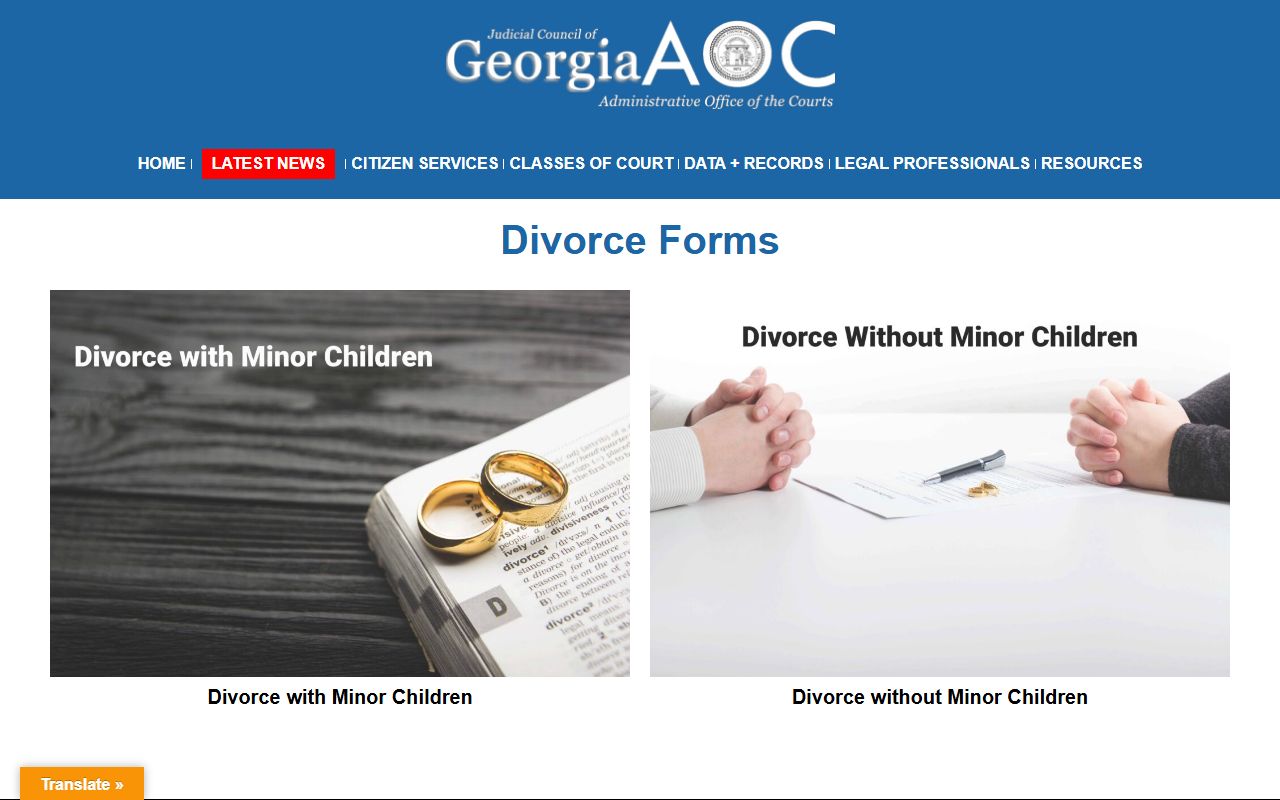
The screenshot shows the self-help divorce forms section of the Georgia Courts website, where unrepresented parties can access standardized forms used in Fayette County and across the state.
Public Access to Peachtree City Divorce Records
Divorce decrees filed in Fayette County are public records under the Georgia Open Records Act, found at OCGA 50-18-70. That means most people can request and receive a copy without needing to show a specific legal interest. The records are not hidden or restricted just because they involve personal matters.
Some records are sealed. A judge can order a file sealed if it contains sensitive information, such as details about minor children or financial data that a party has asked to keep private. Sealed records are not accessible to the general public. If you run into a sealed file, you would need a court order to get access.
For standard public requests, you can ask for a copy in person, by mail, or sometimes online through the county's case management system. The clerk's office can tell you what formats they support and what identification or information you need to bring or include with your request. Note: Certified copies cost a small fee set by the clerk's office; plain copies may cost less.
Legal Help in Fayette County
If you are working through a divorce or trying to get records and you need guidance, several organizations serve residents in the Peachtree City and Fayette County area.
The Georgia Legal Services Program at glsp.org provides free civil legal help to people who qualify based on income. They handle family law cases and can assist with divorce filings, responding to a petition, or understanding what a decree means. Georgia Legal Aid at georgialegalaid.org is another free resource with guides, forms, and referrals for those who cannot afford an attorney.
If you want to hire a licensed attorney, the State Bar of Georgia maintains a directory at gabar.org where you can search for family law attorneys by location. Many family law attorneys in the Fayette County area offer free initial consultations, which can help you understand what you are looking at before committing to legal fees.