
Find East Point Divorce Decree Records
East Point divorce decree records are maintained by the Fulton County Superior Court Clerk in Atlanta, since East Point lies within Fulton County. If you need to locate a divorce decree connected to an East Point case, get a certified copy, or understand how to search the Fulton County court records system, this guide explains the process, what you can expect to find in those records, and how Georgia law governs divorce cases filed here.
East Point Divorce Decree Quick Facts
Fulton County Superior Court Records
East Point residents file for divorce with the Fulton County Superior Court. The clerk's office is at 136 Pryor Street SW, Atlanta, GA 30303. You can reach them at (404) 613-5313, and their website is at fultoncountyga.gov/Superior-Court. Fulton County also has a dedicated marriage and divorce records page at fultoncountycourt.us/divorce-records that is worth checking before you go in person.
Fulton County processes a high volume of divorce cases because it covers Atlanta and surrounding cities including East Point. The clerk's office has developed a set of procedures for records requests. For certified copies, you can visit in person, submit a written request by mail, or use online ordering options if the county offers them. Check the Fulton County court website for current procedures since online services can change.
Have both parties' names ready and, if possible, the case number or approximate year of the divorce. Certified copies typically require a fee. Plain copies cost less but may not be suitable for legal filings, passport applications, or title transfers. Note: Fulton County handles a large volume of records, so mail requests may take longer to process than in-person visits.
The Fulton County Superior Court Clerk website, shown here, is the main portal for East Point divorce decree records. Visit fultoncountyga.gov/Superior-Court to access marriage and divorce records, court services, and current fee schedules.

The screenshot shows the Fulton County Superior Court Clerk website where East Point residents can find information on requesting certified copies of divorce decrees and searching court records.
What East Point Divorce Decrees Contain
A divorce decree is the final order a Superior Court judge signs to end a marriage. It names both parties, gives the date and location of the court, and lays out the terms the court approved. For an uncontested divorce with no children and no major property, the decree can be short. For a case with children, assets, and contested issues, it can run many pages.
When children are involved, the decree sets out legal and physical custody, describes the parenting schedule, and states child support terms. Property and debts are addressed too: the decree says who gets the house, who is responsible for which debts, and how retirement accounts or other assets are split. If alimony was ordered, it appears here. All of these terms become enforceable court orders once the judge signs the decree.
The full case file contains more than just the decree. It holds the original petition, financial statements, settlement agreements, and all orders entered during the case. If you need specific details, such as an agreement about a specific asset or a custody modification order, you may need to request the case file rather than just the final decree. Ask the Fulton County clerk what documents are available and what each costs.
Georgia Divorce Law in Fulton County
Georgia divorce law, found in Title 19, Chapter 5 of the state code, governs every divorce filed in Fulton County including cases for East Point residents. Under OCGA 19-5-1, the Superior Court is the only court in Georgia with authority to grant a divorce. That rule applies whether you live in East Point, Atlanta, or anywhere else in Fulton County.
Before you can file, one spouse must have lived in Georgia for at least six months. OCGA 19-5-2 sets that residency requirement. If you recently moved to East Point from out of state, you may need to wait before your case can be filed here. The case is filed in the county where one of the parties lives.
Georgia law allows 13 grounds for divorce under OCGA 19-5-3. The most common is "irretrievably broken," the no-fault ground. It does not require proving that one party did something wrong. After the other party is served, there is a mandatory 30-day waiting period before the court can grant a final divorce. The petition must be written and verified by the person filing, as required by OCGA 19-5-5.
Georgia's OCGA divorce statute page, shown below, is where you can read the specific laws that apply to East Point cases filed in Fulton County. Visit Justia's OCGA 19-5-3 page for the full text of the grounds for divorce in Georgia.
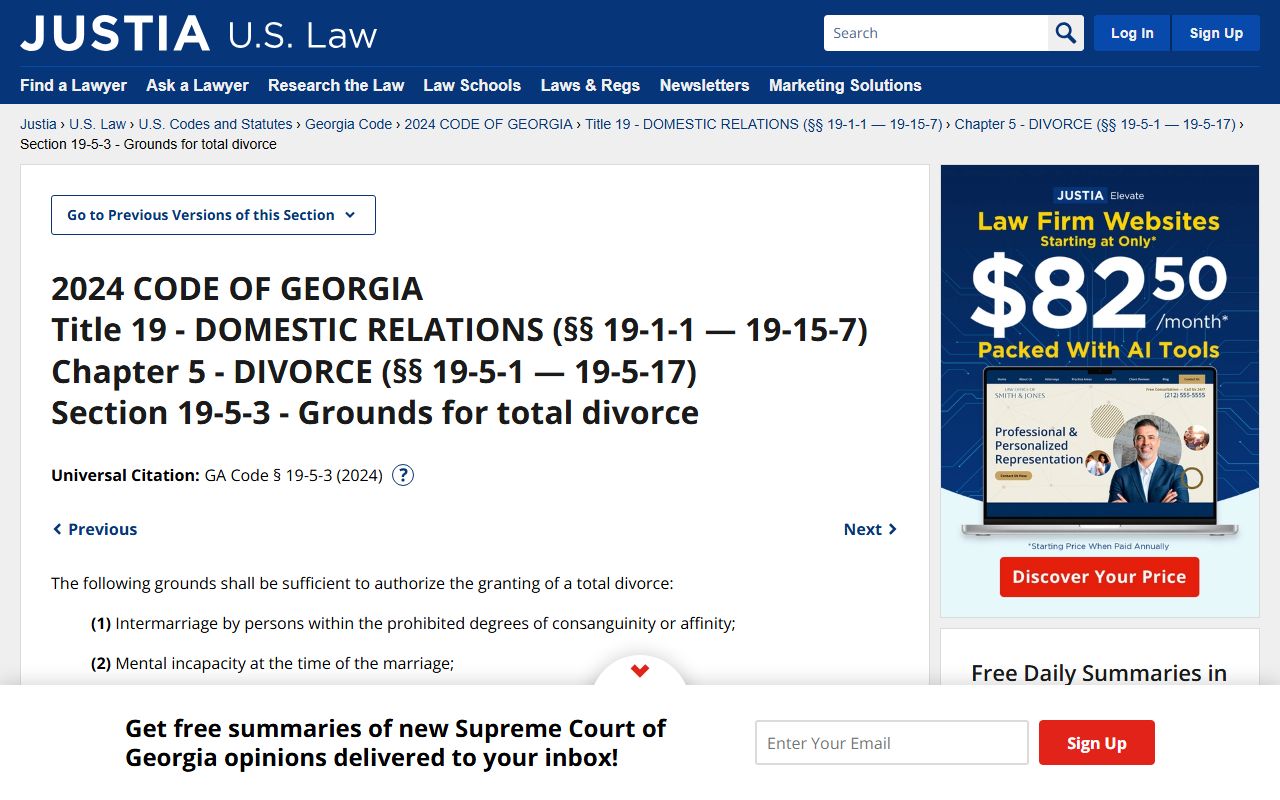
The screenshot shows the Justia page for OCGA 19-5-3, which lists all 13 grounds for divorce in Georgia, including the no-fault "irretrievably broken" ground used in most East Point cases.
Georgia DPH and Statewide Divorce Records
If you are looking for a divorce that happened between 1952 and 1996 and aren't sure which county filed it, the Georgia Department of Public Health maintains a statewide divorce index covering that period. The DPH can confirm that a divorce occurred and identify the county, but it does not provide copies of decrees. It states that "copies of the records are held by the Clerk of the Superior Court in the county where the divorce was granted."
For East Point cases in that range, the DPH index can be a starting point. Once you confirm the county is Fulton, you then go to the Fulton County Superior Court clerk for the actual document. The DPH is at 1680 Phoenix Boulevard, Suite 100, Atlanta, GA 30349, phone (404) 657-2700, website at dph.georgia.gov/VitalRecords.
Public Records and Open Access
Divorce decrees filed in Fulton County are public records. Georgia's Open Records Act at OCGA 50-18-70 gives any person the right to request and inspect public records, including court filings. You don't need to be a party to the case, and you generally don't have to explain your reason for requesting the record.
A judge can seal a file when it contains sensitive information, particularly regarding minor children or confidential financial matters. Sealed records are not available to the public without a court order. For most East Point divorce cases, though, the records are fully accessible through standard request channels at the Fulton County clerk's office. Call ahead or check the website to confirm current procedures and fees before you go.
Legal Help Near East Point
Free and low-cost legal help is available in the Atlanta and Fulton County area for East Point residents dealing with divorce or records matters. The Georgia Legal Services Program at glsp.org provides civil legal help to those who meet income requirements. Georgia Legal Aid at georgialegalaid.org has online self-help resources and referrals at no charge.
If you want to hire an attorney, the State Bar of Georgia at gabar.org has a searchable directory of licensed attorneys by location and practice area. Family law attorneys who practice in Fulton County are familiar with the Superior Court and its procedures. Standardized divorce forms for self-represented filers are available at georgiacourts.gov.