
Find Turner County Divorce Decrees
Turner County divorce decree records are held by the Clerk of Superior Court in Ashburn, Georgia. The clerk's office maintains certified copies of all final divorce orders, the full case files for every divorce action processed in the county, and a complete docket of proceedings. If you need to find a Turner County divorce decree, request a certified copy, or review the terms of a prior court order, the Ashburn courthouse is your starting point. This guide covers the request process, what records contain, applicable fees, and the Georgia laws governing divorce in Turner County.
Turner County Divorce Decree Quick Facts
How to Get Turner County Divorce Decrees
The Turner County Clerk of Superior Court is at 219 E. College Avenue, Ashburn, GA 31714. Call (229) 567-2011 to check office hours and confirm what you need to bring. The county website may have current service details. Turner County is a small rural county; calling ahead before the trip is a good idea. Going in person is the most direct approach; staff can search case records on site and tell you what is available right away.
To request a divorce decree, bring the full legal names of both spouses and the approximate year the divorce was finalized. A case number speeds up the process. Under Georgia law, any member of the public can request court records. You do not need to be a party to the case. Bring photo ID. Fees are paid at the time of the request. If you need a certified copy, which is required for most official purposes, let the clerk know specifically when making your request. Mail requests are accepted; write to the office and ask for the current fee schedule before sending payment.
What Turner County Divorce Decrees Contain
The divorce decree from Turner County Superior Court is the final binding order that ends a marriage and sets out what each party must do going forward. Property division is addressed in the decree: which assets each spouse receives from the marital estate, how the family home is handled, and how financial accounts and other property are allocated. Debts are assigned to one party or the other. If alimony was ordered, the decree specifies the amount and how long it continues. When minor children were involved, the decree contains the full custody arrangement, visitation schedule, and child support terms. Every provision is enforceable by the court.
The full case file at the Turner County courthouse contains more than just the final order. It includes the original divorce petition, any response or counterclaim from the other spouse, financial affidavits, motions filed during the case, temporary orders entered while the case was pending, and any parenting plans submitted when children were involved. The broader record is useful when you need to trace the case history, understand how a term was set, or verify what was agreed upon at an earlier point. Fees apply per page for any documents copied from the file.
A short divorce certificate from the Georgia Department of Public Health only confirms the fact of divorce. It does not contain the terms of the court order. For the actual terms, the Turner County Superior Court decree is the document you need.
Georgia's divorce statute under OCGA 19-5-3 lists all 13 grounds the state recognizes for divorce, published in full through the Justia legal database.
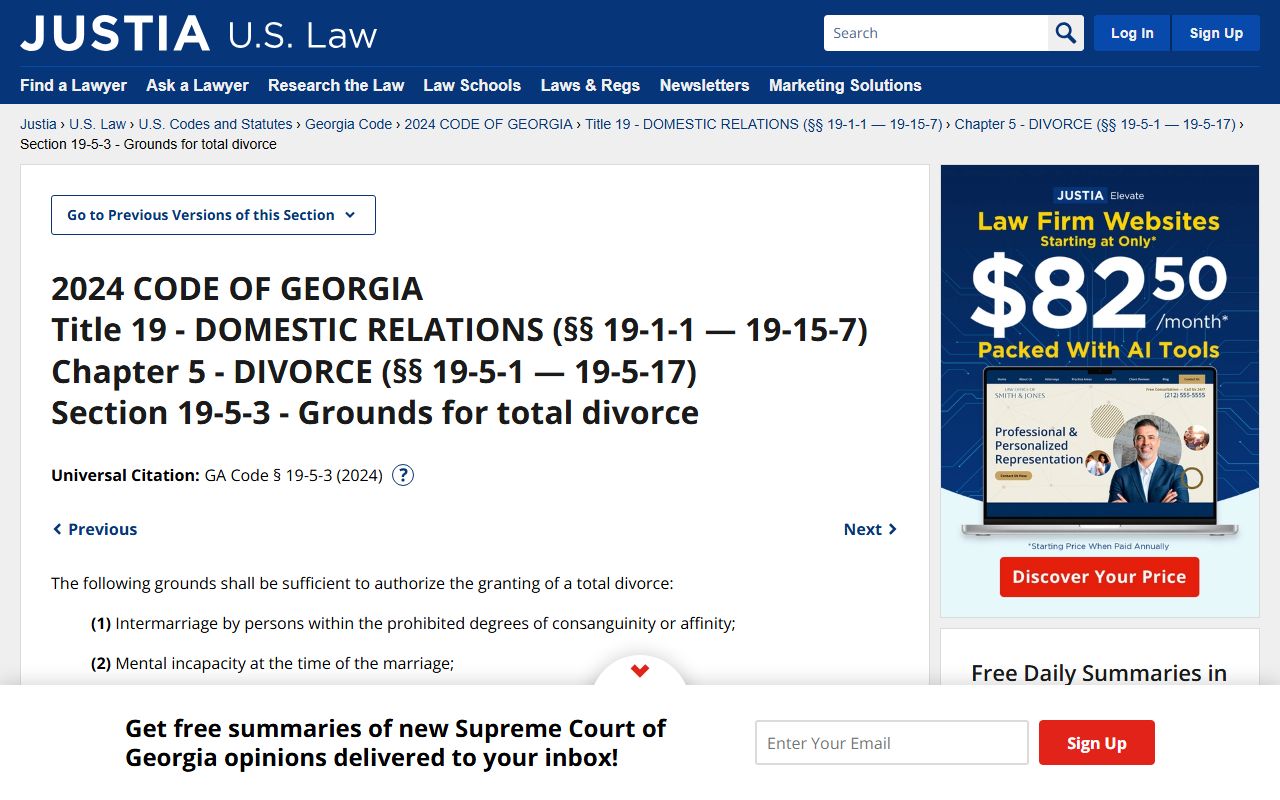
The no-fault ground available under this statute is cited in the majority of Turner County divorce filings and does not require either party to prove wrongdoing.
Turner County Divorce Decree Fees
Copy fees at the Turner County Clerk of Superior Court are consistent with Georgia's standard county court rates. Plain copies of case documents typically cost between $0.50 and $2.50 per page. Certified copies cost more because the clerk's official seal and signature are applied to the document. That certification is required when you intend to use the document in a legal proceeding, file it with a government agency, or submit it as part of a name change application. Ask specifically for a certified copy if you have any official use in mind.
For divorces recorded in Georgia between 1952 and 1996, the Georgia Department of Public Health can confirm whether a record exists in the statewide index. Contact their Vital Records office at 1680 Phoenix Blvd, Suite 100, Atlanta, GA 30349, or call (404) 657-2700. See the Vital Records page for details. DPH verification only confirms the fact of divorce; it does not provide the decree or its terms. For the actual decree, the Turner County clerk holds the only records regardless of the year.
Georgia Divorce Laws in Turner County
Georgia law sets the same framework for divorce in every county, and Turner County Superior Court applies those rules uniformly. The residency requirement in OCGA 19-5-2 says at least one spouse must have been a Georgia resident for six months before a petition can be filed. You file in the Superior Court of the county where either spouse currently lives. Where the marriage took place does not determine where you file.
Under OCGA 19-5-3, Georgia recognizes 13 grounds for divorce. The most commonly used in Turner County is the no-fault ground: the marriage is irretrievably broken. No proof of wrongdoing is needed. Other grounds such as adultery, willful desertion, habitual intoxication, and cruel treatment exist for contested cases but require proof and tend to complicate proceedings. For uncontested divorces in Turner County, the no-fault ground keeps things simpler and faster. Georgia requires a mandatory 30-day waiting period after service before a final decree can be entered. This applies in all cases. Self-represented parties can find official forms at the Georgia Courts self-help portal. OCGA 19-5-1 establishes Superior Court authority over divorce statewide.
Public Access to Turner County Divorce Records
Under the Georgia Open Records Act, divorce decrees in Turner County Superior Court are public records. Any person can submit a request to the clerk without providing a reason or having any connection to the case. The clerk locates the file and provides copies after applicable fees are paid. This openness is the default for court records in Georgia.
Courts can seal records in limited circumstances. Files may be sealed when they contain sensitive information about minor children, financial data posing fraud risks, or when parties have agreed to sealing and the court has approved. Sealed records cannot be released without a court order. Most Turner County divorce cases are not sealed, and a standard public records request to the Ashburn courthouse is sufficient to access those records.
Legal Help in Turner County
Turner County is rural and small, with limited local legal resources. Georgia Legal Services Program serves south Georgia, including Turner County, and provides free legal assistance to income-eligible residents for divorce and family law matters. Apply online or call to check eligibility. Georgia Legal Aid has free self-help tools and guides to Georgia divorce law available to anyone without income qualification.
For contested cases involving significant assets or custody disputes, the State Bar of Georgia has a lawyer referral service. The Georgia Courts website provides forms, court contacts, and resources for self-represented parties in Superior Court throughout the state.