
Richmond County Divorce Decree Records
Richmond County divorce decree records are held at the Clerk of Superior Court in Augusta, Georgia, and are open to the public under the Georgia Open Records Act. As the county seat of Richmond County and home to the Augusta-Richmond County consolidated government, Augusta handles all Superior Court filings for the county, including divorces. The clerk's office is the official source for certified copies of divorce decrees, case file searches, and docket lookups for divorces finalized in Richmond County. This page covers how to request records, what they include, fees, applicable Georgia statutes, and legal resources in the area.
Richmond County Divorce Decree Quick Facts
How to Get Richmond County Divorce Decrees
The Richmond County Clerk of Superior Court is located at 735 James Brown Boulevard, Augusta, GA 30901. Call the office at (706) 821-2460 or visit the Augusta-Richmond County website for current hours and information about the clerk's office. Augusta is a major Georgia city, and the clerk's office handles a high volume of cases. Going in person is the fastest way to get a certified copy of a divorce decree. Arrive with a valid photo ID and the full legal names of both parties. The approximate year of the divorce helps staff locate the correct case quickly.
Mail requests are accepted. Write to the clerk at 735 James Brown Blvd., Augusta, GA 30901. Include both parties' full legal names, the year of divorce, and a self-addressed stamped envelope. A money order for the expected copy fee moves the request along without delays. Call the office first to confirm current fees and accepted payment methods before mailing anything. Richmond County processes many more divorce cases than smaller Georgia counties, which means the clerk's office may be busy during peak times. Plan for some wait time if visiting in person, or allow extra time for mail processing. For older records from the 1970s or earlier, call ahead to ask about retrieval from archival storage.
Augusta residents can also find more detailed information on the Augusta divorce decree records page.
What Richmond County Divorce Records Contain
A divorce decree from Richmond County Superior Court is the judge's final written order ending a marriage. It names both parties, records the date the divorce was granted, and states the court's decisions on all issues before it. Property division, alimony, child custody, parenting time, and child support are addressed in the decree or in attached court orders. The decree is the document that courts, agencies, financial institutions, and government offices require as proof that a marriage was legally dissolved.
The full Richmond County case file is much more than just the final decree. It begins with the petition one spouse filed to start the divorce. The other party's written response follows if one was submitted. Any temporary orders issued by the judge during the pending case are in the file, along with the sworn financial disclosures both parties file in Georgia divorce proceedings. Settlement agreements, parenting plans, and child support worksheets are also included when relevant. Once the judge signs the final decree and the case closes, all of these documents form the permanent public court record at the Augusta courthouse. They are open to inspection and copying during business hours. Some content regarding minor children may be restricted under court rules, but the final decree itself is fully public and accessible to any member of the public, regardless of whether they were a party to the case.
Richmond County Divorce Decree Fees
The Richmond County Clerk of Superior Court charges fees for copies of divorce records. Certified copies, which carry the clerk's official seal and signature, cost more than plain photocopies. Most legal purposes require certified copies. Call (706) 821-2460 before your visit to confirm the current per-page and certification fees. Fees are set within limits defined by Georgia law and can change.
Viewing records in person at the Augusta courthouse is free. Fees apply only when you request copies to take with you. If you need multiple certified copies of the same record, ask whether ordering them all at once qualifies for a lower per-copy rate. Payment at the counter is typically by cash or check. Mail requests generally require a money order. The clerk's office can confirm what they accept when you call. Richmond County has higher case volume than smaller counties, so it is worth calling ahead to understand the process and any specific requirements the office may have for record requests.
Georgia Divorce Laws in Richmond County
All Richmond County divorce cases follow Georgia state law. At least one spouse must have been a Georgia resident for six months before filing, per OCGA 19-5-2. The case is filed in the county where the defendant lives, which for Augusta residents is Richmond County Superior Court. Georgia recognizes thirteen grounds for divorce under OCGA 19-5-3.
Irretrievable breakdown of the marriage is the most used ground in Richmond County and across the state. This no-fault option requires no showing of wrongdoing by either party. The twelve fault-based grounds, including adultery, habitual intoxication, and cruel treatment, are still available and can affect property division and alimony rulings, but they add complexity to the case. After the judge signs the final decree, both parties have 30 days to appeal. If no appeal is filed, the divorce is final at the end of that period. OCGA 19-5-1 defines what a Georgia divorce means and what it accomplishes legally. Richmond County divorce records are public under the Georgia Open Records Act and are accessible to anyone.
Online Access to Richmond County Divorce Records
The Georgia Courts website provides statewide court resources and may include links to online case search tools for Richmond County. As a larger Georgia county, Richmond may have more developed online access for court records than smaller counties. Check the Georgia Courts site or call the clerk's office directly at (706) 821-2460 to find out what online docket search options are available for Richmond County divorce cases.
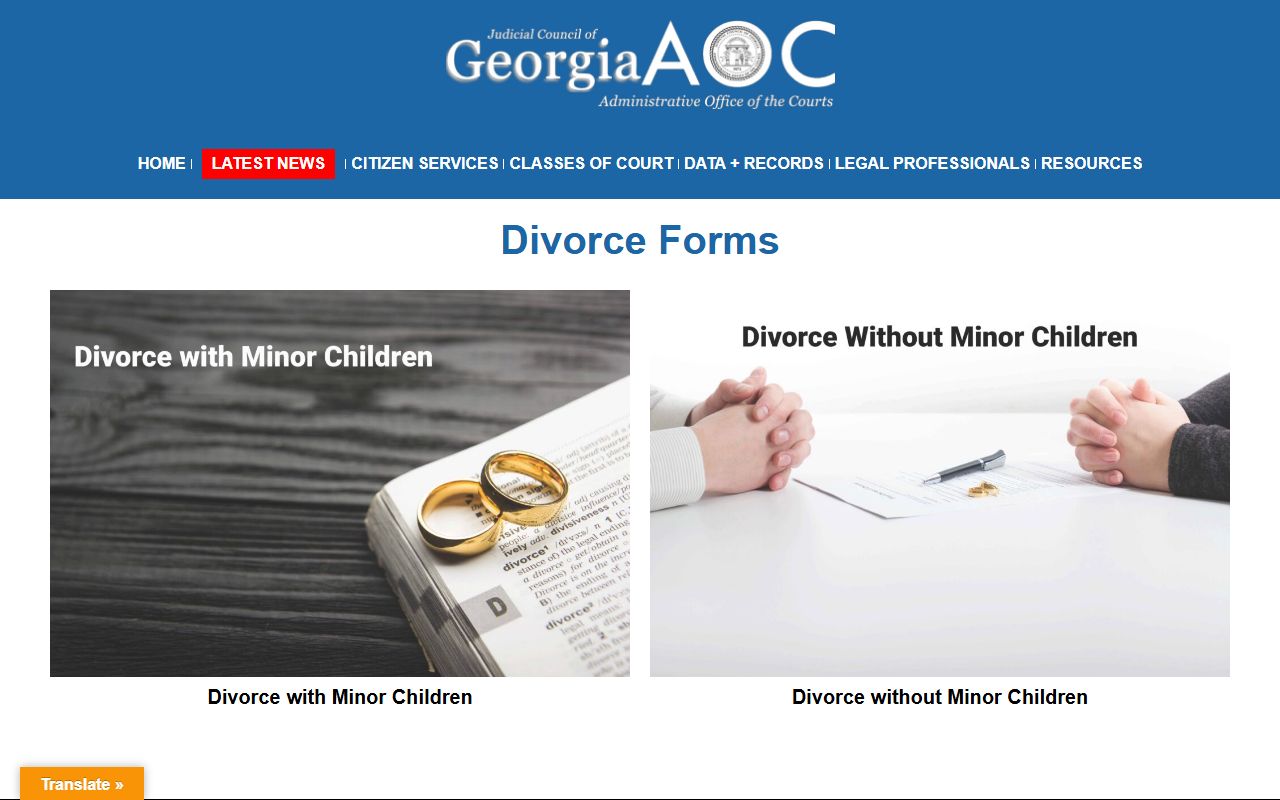
The image below shows the Georgia Courts divorce forms portal, a free statewide resource for standard Georgia divorce forms that are accepted in Richmond County Superior Court.
For divorces that took place between 1952 and 1996, the Georgia Department of Public Health handles verification requests at 1680 Phoenix Boulevard, Suite 100, Atlanta, GA 30349, phone (404) 657-2700, website dph.georgia.gov/VitalRecords. DPH can verify that a divorce occurred in that period but does not provide certified copies of the actual court decree. The Richmond County Superior Court clerk is the source for certified copies.
Legal Help in Richmond County
Richmond County and the Augusta area have a range of legal resources for residents navigating a divorce. Georgia Legal Aid and the Georgia Legal Services Program both serve eligible low-income residents with family law matters. Augusta's larger population means more legal aid resources and private attorneys are available here than in smaller Georgia counties. Income eligibility applies for the free programs.
The Georgia Courts self-help center provides free divorce forms for uncontested cases. These forms are accepted in Richmond County Superior Court and cover the full process from petition to final hearing for cases where both parties agree on all issues. For contested divorces, high-asset cases, or cases involving children and custody disputes, working with a private attorney is strongly advisable. The State Bar of Georgia runs a lawyer referral service that can connect you with family law attorneys who handle Richmond County cases in Augusta. The clerk's office can receive and file your documents but cannot give you legal advice or strategy guidance.