
Gordon County Divorce Records
Gordon County divorce decree records are on file at the Clerk of Superior Court in Calhoun, Georgia, and are open to the public under the Georgia Open Records Act. If you need a certified copy of a final divorce decree, want to search for a case by name, or need to verify that a divorce was finalized in Gordon County, the clerk's office in Calhoun is where you begin. This page covers how to access those records, what they contain, what fees apply, and how Georgia divorce law shapes cases filed here.
Gordon County Divorce Decree Quick Facts
How to Get Gordon County Divorce Decrees
The Gordon County Clerk of Superior Court handles all divorce decree records for this county. The office is at 100 S. Wall Street, Calhoun, GA 30701, with a phone number of (706) 629-9533. The Gordon County website lists current hours and any updates to court services. Visiting in person is the most reliable way to get a certified copy on the same day.
Come prepared with the full legal names of both spouses and the approximate year of the divorce. A case number speeds things up considerably, but clerks can search by name. A valid photo ID is standard for records requests. If an in-person visit is not possible, written mail requests are accepted at the Calhoun address. Include a clear description of what you need, your contact information, and a self-addressed stamped envelope. Call ahead about fees since certified and plain copies are priced differently, and the total depends on the page count of the record.
For background on how Superior Court records are organized and accessed in Georgia, the Georgia Courts website is a useful reference. Divorce cases in Gordon County follow the same filing and record-keeping rules used across all 159 Georgia counties.
What Gordon Divorce Records Contain
A complete divorce case file in Gordon County includes every document filed from the moment the petition was submitted through the final decree. That means the original petition, any responses from the other spouse, temporary restraining orders or support orders issued during the case, financial affidavits, settlement agreements, and the final signed decree. The clerk indexes these files under the case number assigned at filing.
The final decree is the most commonly requested document. It carries the judge's signature and the date the marriage was dissolved. The decree addresses all issues the court resolved: property division, debt responsibility, spousal support, and, if children were involved, custody and support arrangements. Name restoration requests are also included if one spouse asked to return to a prior name. All of these details are public record unless a judge specifically ordered them sealed, which is not common.
For basic divorce verification covering years between 1952 and 1996, the Georgia Department of Public Health Vital Records office can help. That office is at 1680 Phoenix Blvd, Suite 100, Atlanta, GA 30349, phone (404) 657-2700. They hold a statewide index for that time period. For anything before 1952 or after 1996, you must go through the Gordon County Clerk of Superior Court directly.
The Gordon County Clerk of Superior Court in Calhoun is responsible for maintaining all divorce decree records filed in the county, including certified copies and case file access.
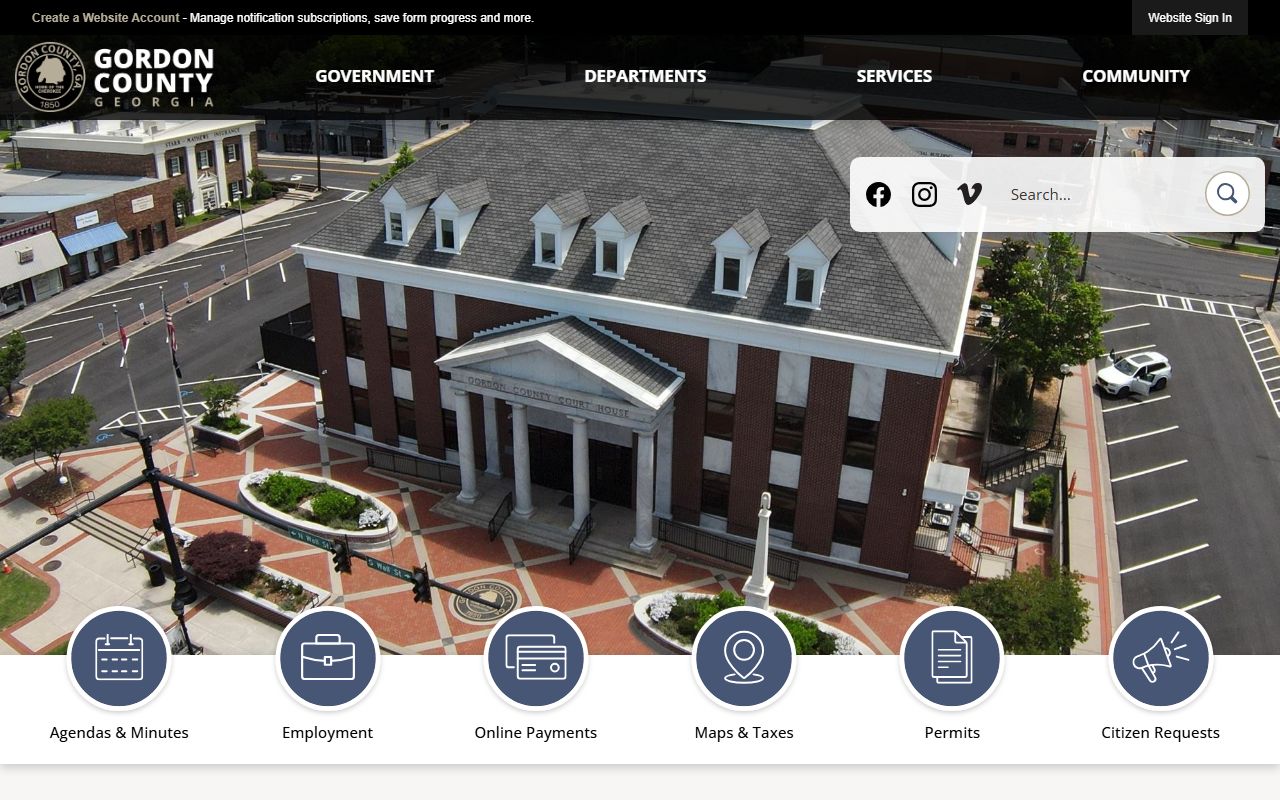
The Gordon County courthouse in Calhoun processes Superior Court civil cases including divorces for residents throughout the county and serves as the official records repository for all final decrees.
Gordon County Divorce Decree Fees
Copy fees at the Gordon County clerk's office cover the work of locating and reproducing records. Certified copies cost more than plain copies because the clerk applies an official seal confirming the document's authenticity. Call (706) 629-9533 for current pricing before visiting. The total depends on page count, so having a case number ahead of time helps estimate the cost.
When filing a new divorce case in Gordon County, you will pay a filing fee to the clerk at the time of submission. Georgia Superior Court filing fees for divorce typically run several hundred dollars depending on case complexity and additional motions. If paying that fee is difficult, Georgia provides a way to ask for relief. A Pauper's Affidavit is a sworn statement of financial hardship that, if approved by the court, can reduce or eliminate the filing fee. Ask the clerk's office for guidance on how to submit one. It does not affect how your case is treated.
Free court-approved divorce forms are available through the Georgia Courts self-help page. Using the correct forms from the start reduces the chance of rejection at the counter and speeds up processing.
Georgia Divorce Law in Gordon County
Georgia divorce law applies the same way in Gordon County as it does everywhere else in the state. Before filing, at least one spouse must have lived in Georgia for six months. This is the residency requirement established by OCGA 19-5-2. Gordon County Superior Court has jurisdiction when the petitioning spouse has lived here for that minimum period. The six months must pass before you file, not before the case wraps up.
Georgia recognizes thirteen grounds for divorce under OCGA 19-5-3. In Gordon County, as across the state, most people choose the no-fault ground, which holds that the marriage is "irretrievably broken." This avoids the need to prove any specific wrongdoing. Fault grounds like adultery, desertion, or cruel treatment are available and may affect how the court handles property or support, but they add time and legal complexity to the process. For most straightforward cases, the no-fault route is the practical choice.
After filing and serving the petition, Georgia law requires waiting 30 days before a final decree can be entered. OCGA 19-5-1 defines what divorce means under Georgia law, and OCGA 19-5-5 lays out what must be in a divorce petition and how the proceedings work. Uncontested cases with all issues agreed upon can move through the Gordon County Superior Court relatively quickly once that waiting period has passed and the paperwork is complete.
Public Access to Gordon Divorce Records
Georgia's Open Records Act (OCGA 50-18-70) gives any member of the public the right to inspect government records, including court case files. Divorce decrees held by the Gordon County Clerk of Superior Court are public records in the vast majority of cases. You do not need to be a party to the divorce to view or copy the record.
Exceptions do exist. Records involving minor children can be partially sealed by court order. Certain financial exhibits may also carry access restrictions. But those are the exception. If you want to search remotely, contact the clerk at (706) 629-9533 to ask whether any online search tools exist for Gordon County court records. Not all Georgia county clerks have built web-based search portals, so an in-person or mail request may be your primary option here.
Legal Help in Gordon County
Self-represented parties can handle an uncontested divorce in Georgia, particularly when both spouses agree on all issues. The free forms on the Georgia Courts site are a good starting point. When there are disputes over children, property, or support, an attorney can prevent costly mistakes.
The State Bar of Georgia offers a referral service that connects residents with family law attorneys. For those who cannot afford private legal help, Georgia Legal Services Program serves rural Georgia and may assist Gordon County residents with qualifying cases. Georgia Legal Aid takes online applications and handles family law matters. Both programs have income limits. The clerk's office in Calhoun can also direct you to any local resources posted at the courthouse for self-represented parties.