
Find Divorce Decrees in Lanier County
Lanier County divorce decree records are held by the Clerk of Superior Court in Lakeland, Georgia. The clerk's office is the direct source for certified copies of final divorce orders, case files, and any related court documents. Most divorce records in Lanier County are public under Georgia law, which means any person can request them without needing a personal connection to the case. This page explains how to request records, what they include, what fees to expect, and how Georgia law applies to divorces filed in Lanier County.
Lanier County Divorce Decree Quick Facts
How to Get Lanier County Divorce Decrees
The Lanier County Clerk of Superior Court is located at 100 W. Main Street, Lakeland, GA 31635. The office phone is (229) 482-3030. Visit the Lanier County official website for updated contact information and office hours. In-person requests are the most direct way to get what you need. Staff can search by name or case number while you wait.
Bring a valid photo ID when you visit. Having both parties' full names and an approximate year of the divorce will help staff locate the case quickly. If you already have a case number, use it. For requests by mail, write to the clerk's office at the address above. Include all available case details, your return address, and payment for copy fees. Call ahead to confirm the current fee amounts before sending anything.
Note: Lanier County is a small county, and in-person visits during regular business hours are the most reliable approach for getting records promptly.
What Lanier County Divorce Records Contain
A divorce decree from the Lanier County Superior Court is the judge's final signed order ending a marriage. It sets out all terms the court approved. That includes how property and debts are divided, whether spousal support is awarded, and the full custody and child support arrangement if minor children are involved. The case file also includes the original divorce petition, the other party's response, any motions filed during the case, financial disclosures, and temporary orders the court may have issued while the case was pending.
A Georgia divorce decree is not the same as a divorce certificate. The decree is the full legal document with all case terms. A certificate is a short document issued by the Georgia Department of Public Health that only confirms a divorce happened. If you need to verify specific terms, the county clerk is your source. For divorces recorded statewide between 1952 and 1996, the Georgia DPH Vital Records office at 1680 Phoenix Blvd, Suite 100, Atlanta, GA 30349 can run a confirmation check. Call (404) 657-2700 for details. Outside that date range, the Lanier County clerk is the only place to look.
Lanier County Divorce Decree Fees
Copy fees at the Lanier County Clerk of Superior Court follow Georgia's general schedule. Plain copies run roughly $0.50 to $1.00 per page. Certified copies, which carry the clerk's official seal, cost more. You need a certified copy when the document must be accepted by a court, agency, or institution as a legal instrument. Ask for the correct type when you make your request. Paying for the wrong format means you might have to come back and pay again.
The Georgia Department of Public Health offers a lower-cost verification service for people who only need to confirm a divorce occurred. Their Vital Records page explains the submission process and current fees. This service only covers the years 1952 through 1996 and gives you a verification letter, not a full decree. For full decree copies in Lanier County, the Superior Court clerk is the right place to go regardless of the divorce year.
Georgia Divorce Laws in Lanier County
Georgia's divorce statutes apply uniformly across all counties. Filing in Lanier County requires that at least one spouse have lived in Georgia for six months, as set out in OCGA 19-5-2. You file where you or your spouse currently lives, not where the marriage took place. The Superior Court in Lakeland handles all divorce cases for Lanier County residents under OCGA 19-5-1, which gives Superior Courts exclusive jurisdiction over divorce in Georgia.
There are 13 grounds for divorce in Georgia, listed in OCGA 19-5-3. The no-fault ground, that the marriage is "irretrievably broken," is by far the most common. It does not require either party to prove fault or wrongdoing. Both contested and uncontested divorces in Lanier County can use this ground. Other grounds exist, including adultery, desertion, cruel treatment, and mental incapacity, but they are less commonly pleaded because the no-fault ground is simpler and less adversarial.
After filing and serving the other spouse under OCGA 19-5-5, Georgia law requires a 30-day waiting period before the court can enter a final decree. Even fully uncontested divorces must wait out this period. The Georgia Courts self-help portal offers downloadable divorce forms for people handling their own cases in Lanier County.
The Georgia Open Records Act covers court records as a matter of state policy, which means divorce decrees filed in Lanier County are public documents once they enter the court system.
Public Access to Lanier County Divorce Records
Georgia's Open Records Act makes divorce decrees and related court documents available to the general public. You do not need to be a party to the case or give a reason for your request. The Lanier County Clerk of Superior Court will search for and provide copies of case records to any person who asks and pays the applicable fee. Online case lookup systems for smaller Georgia counties like Lanier can be limited, so visiting or calling the clerk's office directly is often the most efficient path.
Courts can seal specific records. If a judge seals a file or part of a file, the clerk cannot release those contents without a new court order. Sealing is most common when minor children's interests are at stake or when both parties jointly request it and the court agrees. The clerk will tell you if a record is sealed, but cannot show you what is inside it. Most Lanier County divorce cases are not sealed. Standard divorce decrees are open records available to anyone who asks.
The Georgia Department of Public Health also maintains a statewide index of divorces from 1952 to 1996. If you are not sure which county handled a particular divorce, the DPH Vital Records office can help you narrow it down before you go to the county clerk.
The screenshot below is from the Georgia DPH Vital Records page, which handles statewide divorce verification requests.
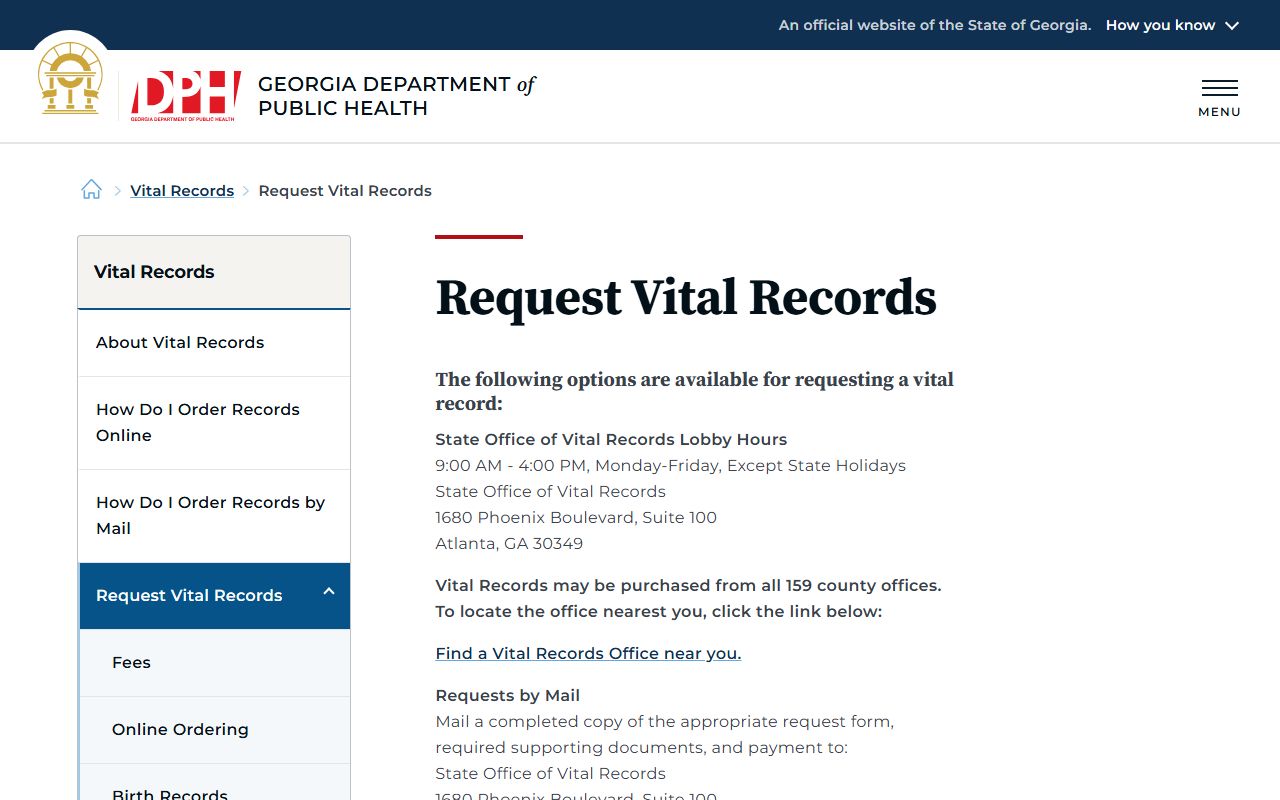
The DPH service is useful for confirming a divorce occurred but does not replace the full decree you can get from the Lanier County courthouse.
Legal Help in Lanier County
Free and low-cost legal help is available in Georgia for people who cannot afford a private attorney. The Georgia Legal Services Program covers rural counties including Lanier and can assist with divorce filings, custody issues, and other family law matters. Eligibility is based on income. You can apply through their website or by phone to find out if you qualify.
Georgia Legal Aid provides online self-help tools, guides, and checklists for people handling their own divorce cases. Their resources are written in plain language and walk you through each step. For more complex cases involving property disputes or contested custody, consulting a licensed attorney is worth considering. The State Bar of Georgia has a lawyer referral service that can connect you with a family law attorney in or near Lanier County. The Georgia Courts website also has court directories and forms for self-represented litigants.